Case Study
Oak Savanna Restoration at Choice Wildlife Management Area
Ninety goats. One steep hillside. Years of failed conventional treatment. This is how Diversity Landworks and The Nature Conservancy are restoring one of Minnesota's most ecologically significant oak savannas — one grazing season at a time.
The Site
Choice Wildlife Management Area sits in Fillmore County near Mabel, Minnesota, in the heart of the Driftless Area — a rugged, glacially unscoured landscape of steep bluffs, oak savannas, and some of the most ecologically significant land in the Upper Midwest. The site is managed in partnership with The Nature Conservancy, which funds and organizes restoration work here as part of its broader effort to protect and recover native prairie and savanna ecosystems along the Mississippi River corridor.
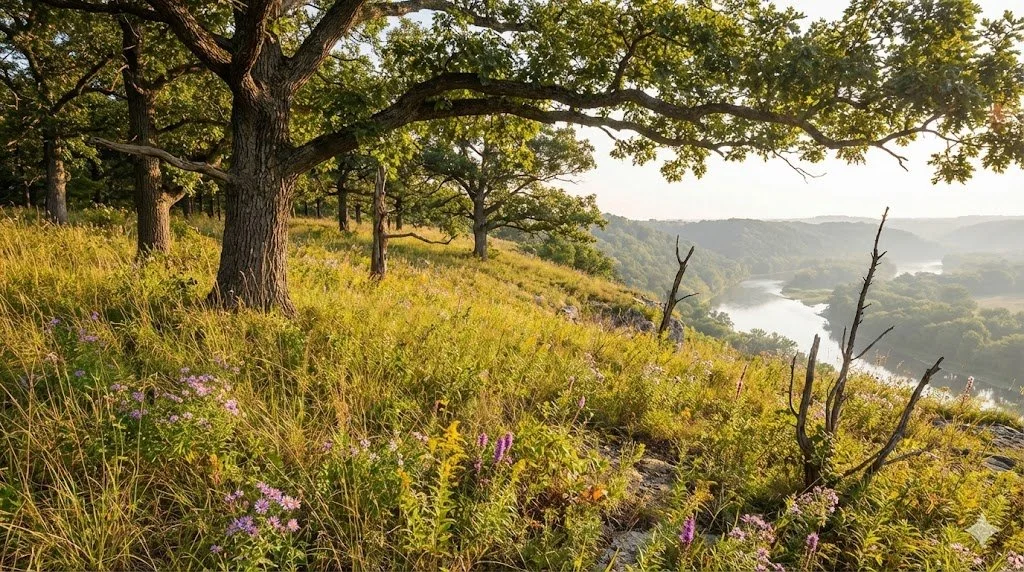
The specific challenge at Choice WMA was a south-facing hillside that had been overtaken by invasive brush. What should have been an open oak savanna — characterized by widely spaced oaks, a diverse ground layer of native grasses and forbs, and abundant sunlight reaching the soil — had instead become a dense tangle of buckthorn, cedar, and other woody invaders.
Why This Site Was Difficult
The slope at Choice WMA is steep enough that conventional mechanical equipment couldn't safely operate on much of it. Hand crews had been deployed in previous years to cut and treat invasive plants — backbreaking work that produced results, but results that didn't hold. The invasives grew back. The investment of labor and herbicide had to be repeated, and the site still wasn't recovering the way the restoration team hoped.
This is a pattern Diversity Landworks sees frequently. Manual cutting and herbicide treatment can knock invasive plants back, but without a sustained biological pressure — the kind that grazing animals provide — the plants rebound. The root systems remain intact, the seed bank remains loaded, and the brush returns.
What the site needed was an approach that could be applied repeatedly, at low cost relative to hand crews, on terrain that machines couldn't reach.
The Approach
Diversity Landworks brought 90 goats to the site and set up rotational paddocks using portable electronet fencing along the bluff. Stocking rate — the number of goats relative to the size of the paddock — was carefully calculated based on the available biomass and the restoration timeline. Kyle Johnson's team has spent over a decade calibrating this balance: too few goats and the pressure on invasive plants is insufficient; too many and you stress the land without achieving lasting control.
The herd at Choice WMA was structured to maintain healthy herd dynamics — a mix of wethers, does, and kids that keeps the animals calm and cooperative in a rugged, remote setting. At a site like this, far from urban areas, Diversity Landworks selects for its most independent and self-sufficient animals: goats that are comfortable navigating cliff faces, sheltering in rock outcroppings, and working steep terrain without close human supervision.
The prescription followed Diversity Landworks' standard protocol: two grazing events per season, repeated over multiple years, to sustain the defoliation pressure needed to exhaust the root reserves of target plants and kill them without chemical intervention.
The Results
After multiple seasons of prescribed grazing at Choice WMA, the transformation is visible. The invasive layer that had shaded out the native ground cover is breaking down. Dead buckthorn stems — what Kyle Johnson calls "blind wood," plants that no longer have the carbohydrate reserves to refoliate — are increasingly visible across the site. As the canopy opens, sunlight is reaching the ground layer again, creating the conditions for native prairie and savanna plants to return.
The longer-term goal is to get the site to what Kyle calls a "flammable state" — open enough that prescribed fire can eventually be used to maintain it, dramatically reducing the ongoing labor and cost of management. Goats get the site there; fire keeps it there.
What This Means for Institutional Land Managers
Choice WMA illustrates how prescribed goat grazing fits into a larger, multi-tool restoration strategy. It isn't a replacement for prescribed fire, mechanical treatment, or hand crews — it's a complement to them, filling the role that large grazing animals played for thousands of years before European settlement removed them from the landscape.
For land managers working with steep, inaccessible terrain and limited budgets for repeated hand-crew deployments, prescribed goat grazing offers a cost-effective, ecologically sound alternative that builds on itself season after season.
Diversity Landworks works with county, state, and federal land managers, nonprofits, and conservation organizations across Minnesota, western Wisconsin, and northeast Iowa. Contact us to discuss your site.
See Us in the Field
Watch Kyle and Tim in the field, where they explain how their process mimics nature’s age-old methods for maintaining ecological balance.