Case Study
Restoring a Private Woodland on the St. Croix River Bluffs
When the owners of a property on the bluffs above the St. Croix River decided they wanted a chemical-free approach to managing invasive brush, they turned to Diversity Landworks. Here’s their story.
Watch Kyle Johnson explain why prescribed grazing was an important part of the land restoration plan at The Acreage in Osceola, Wisconsin.
Summary: When the owners of a property on the bluffs above the St. Croix River decided they wanted a chemical-free approach to managing invasive brush, they turned to Diversity Landworks. Over three grazing seasons, a herd of 35 goats has worked through 50 to 100 acres per year — and the land is already responding. Native sedges and wildflowers are returning to the woodland floor.
Location: Osceola, Wisconsin
The Property
The Acreage sits on the bluffs above the St. Croix River near Osceola, Wisconsin — a stretch of land where the steep, wooded terrain tells a familiar story. Like much of the Upper Midwest, the property had been quietly overtaken by buckthorn, the invasive shrub that shades out native plants, degrades soil ecology, and reduces habitat value for wildlife. The owners knew something needed to change, but they were committed to doing it without herbicides.
That commitment to a chemical-free approach brought them to Diversity Landworks.
The Challenge
Buckthorn doesn't yield easily. Cutting it back stimulates regrowth. Herbicide treatment is effective but introduces chemicals that many landowners — especially those with children, pets, or a strong environmental ethic — are reluctant to use. And on sloped, wooded terrain like the St. Croix bluffs, mechanical equipment is often impractical.
What the land needed was a solution that could navigate steep ground, work without chemicals, and apply sustained pressure on invasive plants over multiple seasons. In short, it needed goats.
The Approach
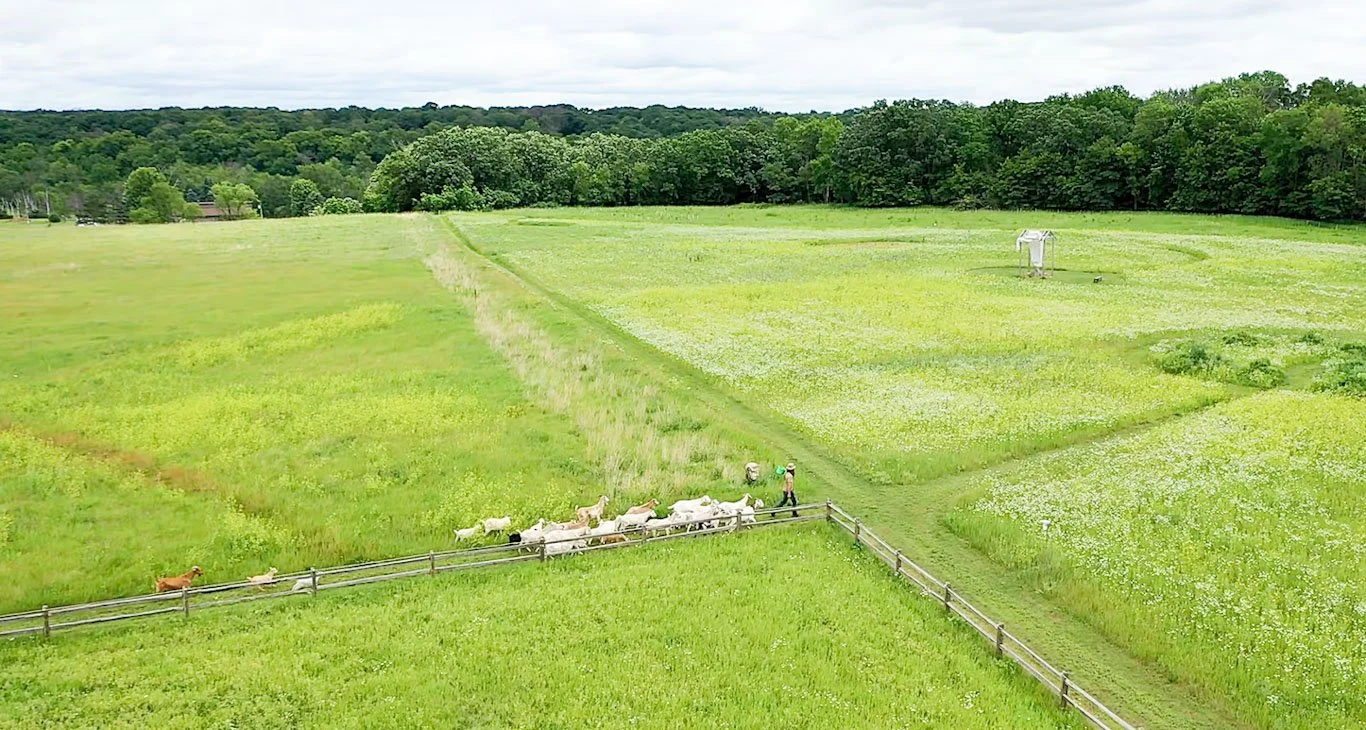
Diversity Landworks brought a herd of 35 goats to The Acreage and established a rotational grazing system using portable electronet fencing. The goats were moved through paddocks in sequence, targeting the densest concentrations of buckthorn and giving grazed areas time to respond before the herd returned.
The prescription called for two grazing events per season — a standard Diversity Landworks protocol that keeps sustained pressure on target plants without overworking the land. Each season, the goats covered between 50 and 100 acres.
The key to the approach is how goats kill woody invasives. Rather than cutting or poisoning the plant, repeated defoliation forces buckthorn to draw down the carbohydrate reserves stored in its root system in order to regrow its leaves. Do this enough times over enough seasons, and the plant exhausts those reserves and dies — leaving the ground open to sunlight and native plants waiting in the seed bank below.
The Results
Three seasons in, the land is measurably healthier. The brush is getting thinner each year. The goats are covering more ground as the canopy opens up and navigation becomes easier. Most encouragingly, native sedges and wildflowers are already returning to the woodland floor — plants that had been suppressed for years under the shade of buckthorn are finding their way back now that light is reaching the ground.
This is exactly the trajectory Diversity Landworks works toward on every site: not just removing invasive plants, but creating the conditions for native ecosystems to recover on their own terms.
What This Means for Private Landowners
The Acreage is a good example of what prescribed goat grazing can accomplish on private residential land. It isn't a dramatic, overnight transformation. Kyle Johnson, co-founder of Diversity Landworks, is the first to say that landscapes degraded over 100 years won't recover in a single season. But it is steady, measurable progress achieved without chemicals, without heavy equipment, and without the back-breaking labor of manual removal.
If you own wooded or brushy land in Minnesota, Wisconsin, or Iowa and are looking for a chemical-free path to restoration, this is what that process looks like in practice.
Interested in a similar approach for your property? Contact Diversity Landworks to discuss your land.
See Us in the Field
Watch Kyle and Tim in the field, where they explain how their process mimics nature’s age-old methods for maintaining ecological balance.